History at Kirkstall Valley Primary: Curriculum Statement
1. Curriculum Intent: Values & Ambition
At Kirkstall Valley Primary School (KVPS), our History curriculum is driven by a desire to ignite curiosity and foster a deep understanding of the complex world our children inhabit. We do not view History as a static list of dates, but as a discipline of enquiry, argument, and identity.
Our curriculum is underpinned by our three core school values:
-
Courage: We challenge our pupils to ask difficult questions, explore contested narratives (such as the legacy of Empire), and understand the courage of those who resisted oppression (from Boudicca to the Home Front).
-
Compassion: We foster empathy by exploring the lived experiences of people in the past, particularly the marginalised—from the poor of Victorian Leeds to the refugees of WWII.
-
Commitment: We are committed to academic rigour. We expect our children to work as historians: analysing sources, constructing arguments, and mastering complex vocabulary.
The "Golden Threads"
To ensure our curriculum is joined-up, we have identified key Second-Order Concepts (Golden Threads) that recur from Year 1 to Year 6. These concepts allow children to build a cumulative schema of understanding:
-
Settlement & Migration: From Stone Age nomads to the Windrush generation.
-
Empire & Civilisation: From the Roman Empire to the Islamic Golden Age and the British Empire.
-
Power & Democracy: From the Kings of Sparta to the Prime Ministers of WWII.
-
Conflict & Resolution: From the Viking raids to the Blitz.
-
Evidence & Truth: How do we know what happened? (From Samuel Pepys’ diary to the Vindolanda tablets).
2. Context & Rationale: Why This Curriculum?
Our curriculum is not "off-the-shelf"; it is bespoke to KVPS. It has been designed specifically to address the demographic needs of our cohort (Inner-city, high PP, high EAL, diverse).
1. Representing Our Community
We reject a purely Eurocentric view of the past. It is vital that our diverse student body sees their heritage represented academically.
-
Implementation: We teach Early Islamic Civilisation (Baghdad c.900AD) to demonstrate that progress and science are global pursuits. We teach the multi-ethnic nature of the Roman Army and the Commonwealth contribution to WWII.
2. Rooting Children in Their Locality
Many of our children are transient or new to the area. We use History to foster a sense of belonging and "pride of place."
-
Implementation: We study Victorian Leeds to understand the streets we walk on. We investigate the history of our own school building (KVPS Through Time) and local industries like Waddingtons (Toys).
3. Closing the Vocabulary Gap
Recognising that many pupils join us with lower-than-average language baselines, our History curriculum is a driver for literacy.
-
Implementation: We explicitly teach Tier 2 and Tier 3 vocabulary (e.g., 'civilisation', 'monarchy', 'conquest', 'propaganda') in every unit, ensuring children can articulate their thinking with precision.
3. The Journey: From EYFS to Key Stage 3
Our curriculum is sequenced to ensure a smooth progression of knowledge and skills.
Early Years: The Roots
In EYFS, history is embedded in "Understanding the World." Children explore the concept of "Past and Present" through storytelling and their own life history. They learn to distinguish between "now" and "then," laying the groundwork for chronology.
Key Stage 1: Personal & Local
We move from living memory to national history.
-
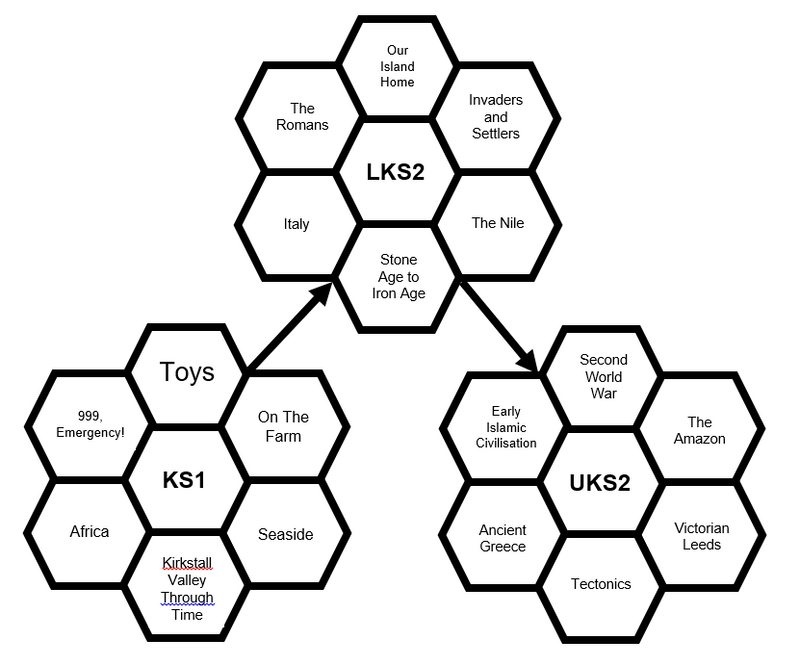
Year 1: Starts with the tangible—their own Toys and the history of KVPS.
-
Year 2: Expands to national events like The Great Fire of London, introducing the concept of Significance and Evidence.
Lower Key Stage 2: Chronology & Invasion
Children encounter the vast scale of Prehistory (Stone Age) and the drama of Invasion (Romans, Anglo-Saxons, Vikings). They begin to understand cause and effect and the shaping of the British nation.
Upper Key Stage 2: Complexity & Connection
We introduce abstract concepts and concurrent chronologies.
-
Year 5/6: Children compare Ancient Greece with Islamic Civilisation, analysing contrasting political systems. They tackle the complex social history of Victorian Leeds and the global conflict of WWII.
Readiness for Key Stage 3
We actively prepare pupils for secondary history. By the end of Year 6, our pupils can:
-
Construct balanced arguments (preparing for GCSE essays).
-
Evaluate the utility and bias of sources (Nature, Origin, Purpose).
-
Understand the "Long Arc" of British history, ready for the KS3 study of the Normans and the Industrial Revolution.
4. Implementation: Pedagogy & Inclusion
Substantive vs. Disciplinary Knowledge
Our planning explicitly separates Substantive Knowledge (the facts, dates, and people) from Disciplinary Knowledge (how historians work). We teach children not just what happened, but how we know.
Adaptive Teaching (Inclusion)
We have a high proportion of SEND and EAL pupils. We do not differentiate by lowering expectations; we scaffold up.
-
Visuals & Artefacts: We use concrete objects (e.g., Roman coins, Victorian toys) to make abstract concepts tangible.
-
Oracy: We use sentence stems and structured talk to help children verbalise their historical understanding before writing.
-
Review: We use retrieval practice (quizzes, timelines) to ensure knowledge sticks in the long-term memory.
5. Impact
The impact of our curriculum is seen in our children’s confidence. They leave Kirkstall Valley as articulate, critical thinkers who understand that history is not just a story about the past, but a tool for understanding their present and shaping their future.