
English: Phonics and Spelling
Phonics & Spelling
At Kirkstall Valley Primary, we are committed to ensuring every child develops the confidence and skills to become a fluent reader and an accurate speller. Our English curriculum encompasses phonics, reading, writing, handwriting, and EGPS (spelling, punctuation, and grammar).
Phonics: The Foundation of Reading
We teach early reading using the Little Wandle Letters and Sounds Revised programme, a DfE-accredited systematic synthetic phonics scheme.
How we teach it:
-
Daily Sessions: In Early Years and Key Stage One, phonics is taught in a discrete daily session.
-
Consistency: We use consistent routines and resources across the school. Children use specific 'mantras' to help them remember rules, and we use 'sound buttons' to help them identify Grapheme-Phoneme Correspondences (GPCs)—the link between sounds and letters.
-
Application: Children consolidate their learning during guided reading lessons using Big Cat for Little Wandle books. These books are perfectly matched to the child’s current phonics knowledge, ensuring they can read fluently and with confidence.
Support & Intervention: We believe in keeping up, not catching up. Any child requiring extra practice receives tightly structured, daily intervention to close gaps immediately. For some pupils in Year 2 and Key Stage Two, we continue to provide small, targeted groups using phonically decodable texts to ensure their foundations are secure.
Spelling: Building on Phonics
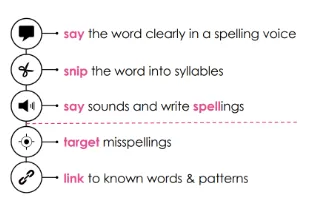
As children progress into Key Stage Two, the focus shifts from pure phonics to a deeper understanding of word structures. We follow the Sounds & Syllables curriculum, which is taught discretely three times per week.
Our Approach: We move beyond simple memory tests by teaching children to analyse words. Our lessons focus on:
-
Morphology: Understanding root words, prefixes, and suffixes.
-
Etymology: Exploring the origin of words and how their meaning has evolved.
-
Phonemes & Syllables: Breaking words down into sounds and beats to make them easier to spell.
Homework & Practice:
-
Weekly Patterns: Children focus on a specific spelling pattern or rule each week.
- Statutory Spellings: We also cover the National Curriculum statutory word lists for Years 3/4 and 5/6.
We encourage children to practise these spellings regularly at home.
Targeted Support (Nessy)
For children in Key Stage Two who require additional support with decoding and spelling, we utilise the Nessy intervention programme. This provides a personalised approach to help children build confidence and independence in their writing.
Assessment
-
Phonics: Assessments are completed every half-term to track progress and identify any gaps that require immediate intervention.
-
Spelling: Teachers test weekly and monitor the application of spelling rules within the children's independent writing.
Y3 Overview Tier 3 Overview
Y4 Overview Tier 4 Overview
Y5 Overview Tier 5 Overview
Y6 Overview Tier 6 Overview
Statutory Spellings are also taught in Key Stage Two in Y3 / 4 and Y5 / 6.
YEAR 3 & 4 PDF HERE Year 3 & 4 Statutory Spellings
YEAR 5 & 6 PDF HERE Y5 & 6 Statutory Spellings
Sounds and syllables information for parents and carers
The Nessy intervention programme is used for those children who require extra support in decoding and spelling in Key Stage Two.
For further information about our English curriculum, please speak to Mrs Bridges.
Our governor with responsibility for English is Cath Scanlon.


